
Written by: Yuan Gao – Product Innovation Scientist at Lignopure
Lignin is recognized as a polyphenolic material which is also one of the main constituent of superior plants. Beside cellulose, lignin is the most abundant natural material on Earth. Usually, lignin is obtained as a side-stream product of the cellulose production and the paper pulp industry.
Despite many existing research and developments, the main area of lignin’s application is still petroleum exploration or bio-fuel production, in which lignin is used as surfactant to enhance the efficacy of oil recovery or is burned to generate heat and power, respectively. Therefore, Lignin remains underutilized.
Lignin, the new natural SPF-Booster for cosmetic formulations
Recently, growing attention has focused on lignin as a new safer and biodegradable raw material as SPF booster in sunscreen products or personal care products with SPF. Due to its properties, the possibility of lignin to reduce the usage of common synthetic ingredients in cosmetic products is highly promising.[1,2] However, raw lignin is unfit for cosmetic applications.
In this context, Lignopure identified lignin’s potential in the cosmetic world and has developed its own patented particle technology to process lignin, making it suitable for cosmetic applications and maximizing its functionality. Thus, the first non-nano lignin powder ingredient was born. LignoBase is the name of this groundbeaking ingredient line that is specifically designed for multifunctional use and benefits in cosmetic formulations.
LignoBase ingredient line range
Produced from clean, sustainably sourced plants, each LignoBase ingredient is developed using Lignopure’s patented particle technology. The unique polyphenolic molecular structure of each ingredient offers key benefits, including the ability to boost SPF, protection against free radicals and antioxidant activity within formulations. These innovative line includes three variants named by its undertone:
- LignoBase Cool BE25: The non-nano lignin powder ingredient with cool (redish-purple) undertone sourced from birch trees.
- LignoBase Neutral PS25: The non-nano lignin powder ingredient with neutral undertone sourced from pine trees.
- LignoBase Warm WS25: The non-nano lignin powder ingredient with warm (yellow) undertone sourced from wheat straw.
LignoBase’s mechanisms of SPF boosting effect
After demonstrating the SPF-boosting properties of lignin, many questions arise regarding the mechanisms behind its effectiveness. Based on LignoBase’s unique chemical and physical characteristics, we can identify four key mechanisms that may explain how it enhances SPF.
Photostabilization of BMDBM
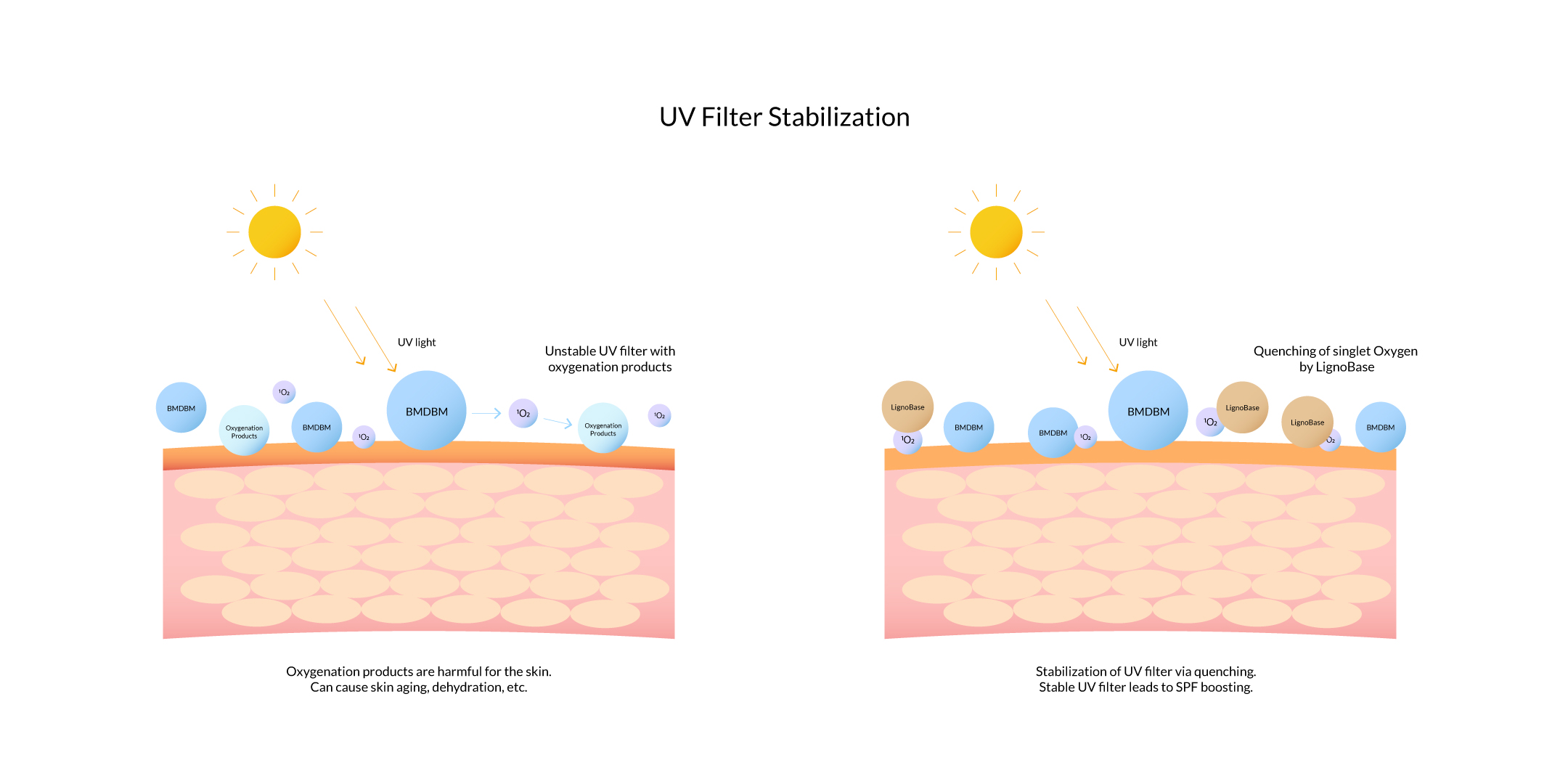
BMDBM (Butyl Methoxydibenzoylmethane) is a widely used UVA filter in sunscreen formulations, known for its ability to absorb UVA radiation effectively. However, one significant drawback of BMDBM is its instability when exposed to UV light. With prolonged exposure to sunlight, BMDBM can undergo a transformation into a less effective form known as the keto form. This transformation is detrimental as it significantly reduces the compound’s ability to protect the skin from harmful UVA rays, which are known to contribute to skin damage and photoageing.[3]
Moreover, this conversion process can lead to the formation of harmful byproducts, particularly when the excited form of BMDBM interacts with molecular oxygen present in the environment. This interaction generates singlet oxygen, a reactive oxygen species that can cause oxidative stress and further damage skin cells. The presence of singlet oxygen poses an additional threat because it can react with the normal enol form of BMDBM, further diminishing its UVA absorbance and protective efficacy. As a result, the degradation of BMDBM not only compromises its effectiveness as a UV filter but also increases the risk of skin damage from prolonged sun exposure. [3,4]
One way to protect BMDBM from this degradation is to add a quencher, which can absorb the energy from the excited form and help prevent its breakdown. However, this quencher itself can become excited and degrade, potentially leading to harmful products as well. LignoBase holds lignin’s complex phenolic polymer, which contains a variety of chemical functional groups, such as phenolic hydroxyl, carboxylic, carbonyl, and methoxyl groups, which contribute to its powerful antioxidant properties.[11] These functional groups enable lignin to effectively neutralize harmful singlet oxygen produced during the degradation process, making it a promising candidate for enhancing the stability of BMDBM and therefore enhancing the filter’s protective properties.
Synergetic effect between lignin and UV filters
J-aggregation refers to the stacking of aromatic rings found in lignin and UV filters, e.g. OMC (octyl methoxycinnamate). This interaction occurs due to the attractive forces between the electron-rich and electron-deficient regions of the aromatic molecules. When these rings stack together, they form larger structures that can alter how the material absorbs UV light.
Specifically, this aggregation reduces the energy needed for the π-π* transition (the process by which the material absorbs UV light) and creates a larger conjugated structure. As a result, the UV absorption spectrum of the material shifts toward longer wavelengths, a phenomenon known as spectral redshift. This broadening of the UV absorption spectrum means that the materials can absorb a wider range of UV radiation, enhancing the overall effectiveness of the sunscreen.[5,6]
Light scattering effect
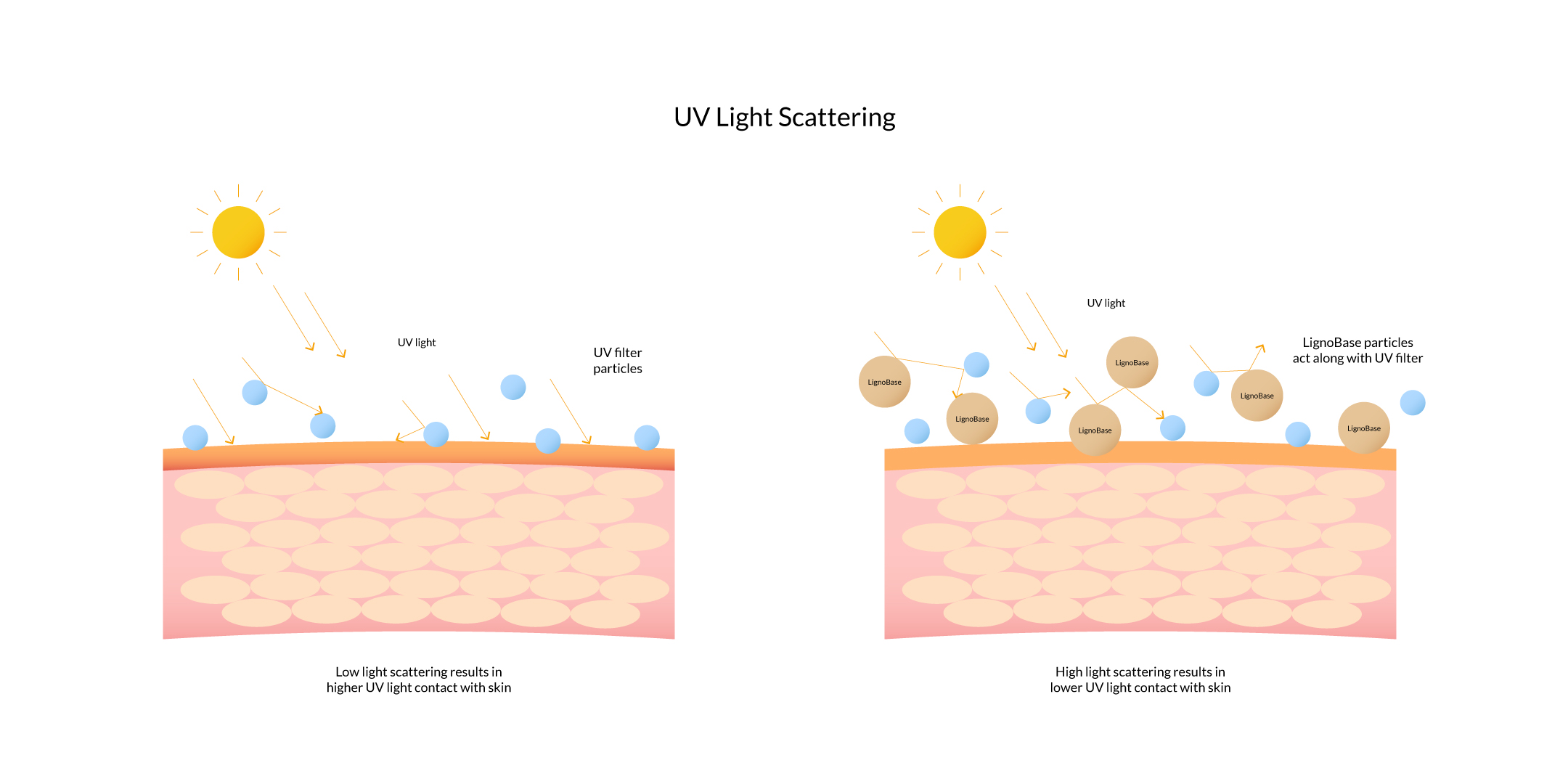
The use of light-scattering particles to boost UV protection in sunscreens is a well-known approach, and Lignopure’s innovative micron sized lignin particles excel in this area. The non-nano lignin particles effectively scatter light, and when incorporated into sunscreens, its scattering effect increases the optical path length of UV radiation, ensuring that the light is more likely to interact with dissolved or dispersed UV filter molecules before reaching the skin, thereby enhancing the UV protection. [7,8]
Film forming capacities
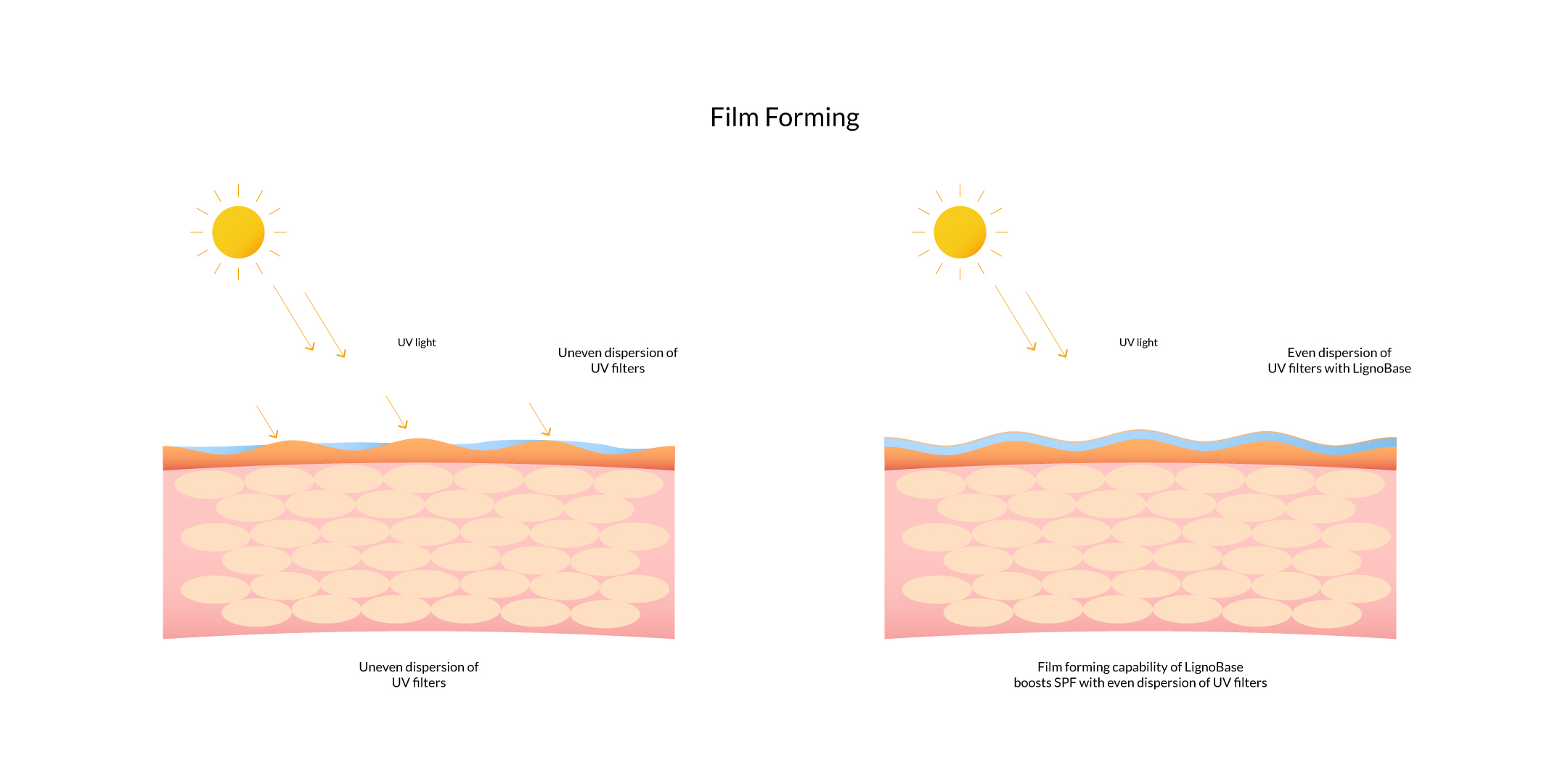
The UV protection of sunscreen products depends on not only the intrinsic absorption properties of the UV filter system, but also the distribution of the sunscreen products when they are topically applied on skin.[7,9] Understandably, skin surface is uneven, sunscreen products which can form film with uniform thickness to cover more skin surface should have better UV protection than those without this property.
Correspondingly, this can affect the in-vivo and in-vitro SPF value. Following the same theory, the more homogenous the UV filters spread on the skin, the better the UV performance the sunscreen will have. Therefore, it is necessary to add film former compounds in sunscreen formulations to increase its fil forming ability and as a result, the SPF value increases as well. Cellulose is one of the most important film forming materials.[10] In the extraction process, cellulose cannot be completely separated from lignin. Therefore, the cellulose residue naturally attached to the polyphenol structure can give lignin extract the film forming capacity. The amount of cellulose residue depends on lignin’s extraction process.
Conclusion
LignoBase SPF Boosting mechanisms together with different in-vivo and in-vitro SPF testings emphatize the potential of lignin in non-nano powder form as as an excellent alternative for cosmetic brands and formulators to achieve the desirable or higher SPF in their formulation by using an upcycled and natural bio-based material that is safe for human health and the environment.
From multifunctional makeup and skincare to tinted suncare or haircare with SPF, LignoBase is the perfect ally for consumers looking for products that offer protection against UVA and UVB radiation without compromising on their sustainable values.
Reference
[1] Nur I, Mohamed Noor N, Rasid Z, El Enshasy H, Wan A, Izyan N. Lignins as natural active ingredients for cosmetics: A Review. Bioscience Research. 2022; 19. 1050-1066
[2] Watkins D, Nuruddin M, Hosur M, Tcherbi-Narteh A, Jeelani S. Extraction and characterization of lignin from different biomass resources. Journal of Materials Research and Technology. 2015; 4, 26-32
[3] Lhiaubet-Vallet V, Marin M, Jimenez O, Gorchs O, Trullas C, Miranda MA. Filter filter interactions. Photostabilization, triplet quenching and reactivity with singlet oxygen. Photochemical & Photobiological Sciences. 2010; 9, 552–558
[4] Afonso S, Horita K, Sousa e Silva JP, Almeida IF, Amaral MH, Lobão PA, Costa PC, Miranda MS, Esteves da Silva JC, Sousa Lobo JM. Photodegradation of avobenzone: stabilization effect of antioxidants. Journal of Photochemistry and Photobiology B: Biology. 2014; 140, 36–40
[5] Qian Y, Qiu XQ, Zhu SP. Sunscreenperformance of lignin from different technical resources and their general synergistic effect with synthetic sunscreens. ACS Sustainable Chemistry & Engineering. 2016
[6] Würthner F, Kaiser TE, Saha-Möller CR.J-Aggregates: From serendipitous discovery to supramolecular engineering of functional dye materials. Angewandte Chemie International Edition. 2011; 50, 3376-3410
[7] Sohn M. UV booster and photoprotection. In: Wang, S., Lim, H. (ed.). Principles and Practice of Photoprotection. 2016
[8] Herzog B. Prediction of sun protection factors by calculation of transmissions with a calibrated step film model. Journal Of Cosmetic Science. 2002; 53, 11–26
[9] Shaath NA. Ultraviolet filters. Photochemical & Photobiological Sciences. 2010; 9, 464–469
[10] Meftahi A, Samyn P, Geravand SA, Khajavi R, Alibkhshi S, Bechelany M, Barhoum A. Nanocelluloses as skin biocompatible materials for skincare, cosmetics, and healthcare: formulations, regulations, and emerging applications. Carbohydrate Polymers. 2021; 278
[11] Kabir AS, Yuan Z-S, Kuboki T, Xu C. Development of Lignin-Based Antioxidants for Polymers. In: Production of Materials from Sustainable Biomass Resources. 2019; 39–59